Sunday, September 16, 2018

Machu Picchu Day 1: Inti Punku (Sun Gate)

Peru Day 4: 

We awoke early the next morning to take a taxi to the Poroy train station. Given the early hour of the morning, it was quite cold! The station had indoor gas-powered heat lamps which made the wait more bearable. At 7:30 AM, we boarded the PeruRail Vistadome train. The Vistadome had a more limited schedule, but had skylight windows to allow better views of the valley as we traveled. The train’s destination was Aguas Calientes, the town just outside Machu Picchu where most visitors stay.

The train was comfortable, with cabin-style seating in pods of 4 with a table in between. We 3 were seated with Lupe, a Puerto Rican woman traveling with friends seated in the adjacent pod. We all became fast friends over the 3 hour ride. Our chance meeting is also a good example of the influence of random events: upon exchanging itineraries, we realized that we shared the same itinerary for the next day, but the Puerto Ricans were also visiting Machu Picchu upon arrival! Our initial plan had us relaxing in Aguas Calientes that day, but the thought began to form upon further reflection: why travel so far and not get the most out of seeing Machu Picchu itself?

The ride paralleled the Urubamba river, which criss crossed the train tracks as we headed deeper into the mountains. The popular trekking Inca trail also started along the way, as we could see small bands of hikers taking off on their adventure. We also saw many beautiful vistas of snow-capped mountains, towering over the train.

After about three hours, we arrived at Aguas Calientes. The town itself was a collection of shops, restaurants, and hotels, split by the river itself. Three pedestrian bridges connected the two halves of the town. The seed of the idea of adding a second session of Macchu Picchu had fully germinated, so we went straight to the ticket office to see if they had extra tickets. Usually, one must book months in advance, but luckily they had a few extra slots. We checked into our hotel, then quickly made our way back to the bus depot. The bus ticket line was even longer than the Machu Picchu line! They only took cash, but luckily that included US dollars, so we were able to snag our tickets before the next bus left.

Bridges in Aguas Calientes


Every day, there are two windows of time to enter Machu Picchu, a morning session and an afternoon session. We joined in the afternoon session, taking a winding 30 minute bus ride up to the entry gate to Machu Picchu. Your ticket and passport are checked at the gate, and then a small pathway leads into the citadel. As one enters, there are several circuits around the site. We took the upper trek, which required a 15 minute climb up a set of stairs. At the end, a view of the citadel down below opens up. 
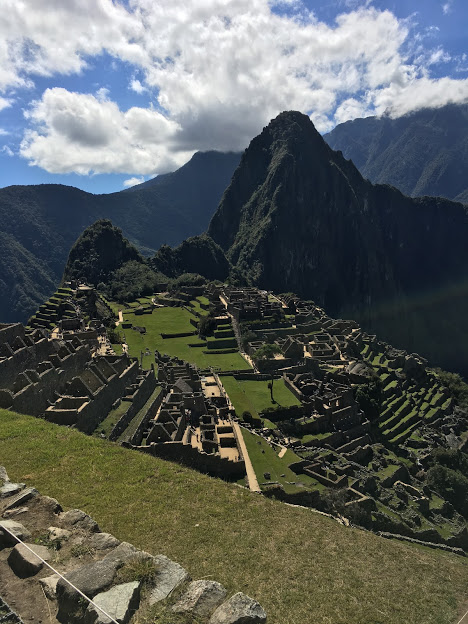

Machu Picchu citadel with Huayanapicchu peak in the background


From there, we decided to hike to the Sun Gate, or Inti Punku. The Sun Gate is about a two hour hike away from the site up an adjacent mountain. Along the way, we were greeted by several free-ranging llamas! Sadly, they didn’t share our excitement in seeing us, as they continued to graze as we walked by. About half way up, there is a guard house, which in reality is a small outcropping of stones. Mom decided to halt here, while Dad and I continued onwards to the Gate itself. After about 30 more minutes hiking, we reached the Gate. Peering back, we could see the citadel off in the distance. As the sun was starting to set, we could see its rays extending across the valley. It is still remarkable how the entire site was designed to be in harmony with its surroundings and the heavens above.

Machu Picchu citadel as seen from Inti Punku (Sun Gate)


As the rays lengthened, the site was closed, and we headed back down, picking up Mom along the way. We took the bus ride back, and quickly wound down for the night, looking forward to a second chance at Machu Picchu the next day by morning.

Saturday, September 15, 2018

Sacred Valley: Chincero, Ollantaytambo, Pisac, and Sacsayhuaman

Peru Day 3: Using Viator, we booked a day-long guided tour around Sacred Valley, the Inca sites in the valley around Cusco. The trip included Sacsayhuaman ( 12136 ft ) in addition to Ollantaytambo, Pisac and Chinchero. Our guide Elvis picked us up at 7am from our hotel. As we were the only ones the tour, we had some flexibility to decide which order we went in, so we decided to start at the farthest point Ollantaytambo.

The city of Cusco is at an elevation of 11152 feet surrounded by mountains on all sides. On our way, we enjoyed beautiful sunrise in the mountains. We passed by Poroy, the train station from which will take a train to Aguas Calientes / Machu Picchu the next day. We saw Cusco city waking up and as we moved away from city roads became less crowded.

Our first stop was Chincero, a site about 12000 feet above sea level, higher than Cusco. After passing the newer town below, we parked and walked up steps for about 10 minutes to the site of the old Incan palace or summer resort. The old Incan walls still remain, but the main structure is a church, built by the conquistadores around 1607. The walls were a good example of the ‘dry’ technique, in which each stone was fitted together without the use of mortar. Terraces still surround the area, with farming actively practiced. Elvis led us to an open plain, where many batches of potatoes were undergoing a drying / desiccation process in the open air prior to storage. In the main square, there were local people selling handicrafts, many woven. After about twenty minutes, we returned to the car.
 
The plains outside Chincero

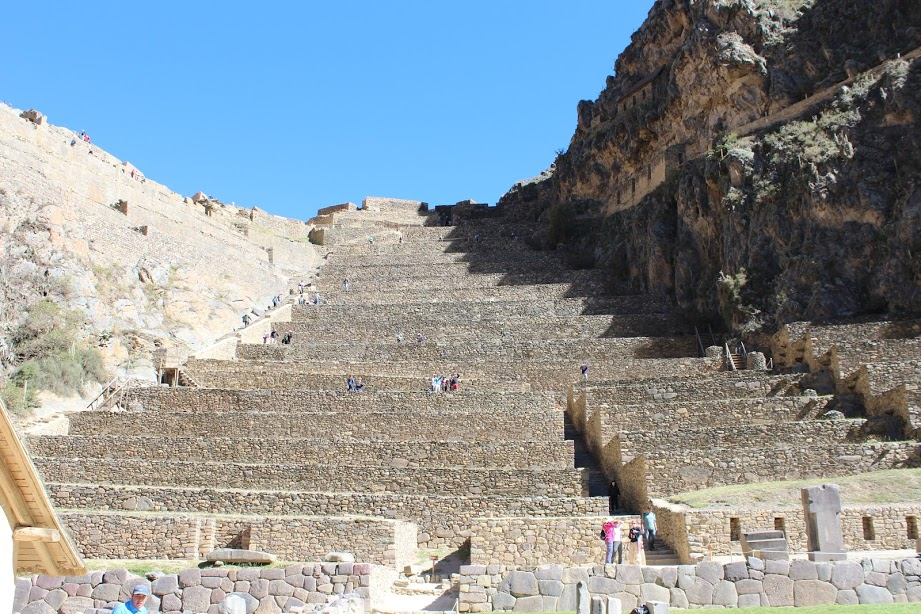
Ollantaytambo was our next stop. The site is an impressive fortress / palace built by Pachacuti just before the time of the Conquistadores. A series of canals brought water to the area from the Urubamba river. We toured the ground level temples first, before I climbed the steps to the top. Along the twenty minute climb, one could see terrace farmers working on the steep cliffs running alongside the site.


Ollantaytambo

The top featured the Templo del Sol, or Sun Temple. Unfortunately due to time constraints, I had to turn back and head down after reaching the top. The valley and trail to the Military Site were visible, but would likely have taken at least 30 more minutes. Elvis had us on a tight schedule though!

Templo del Sol at Ollantaytambo

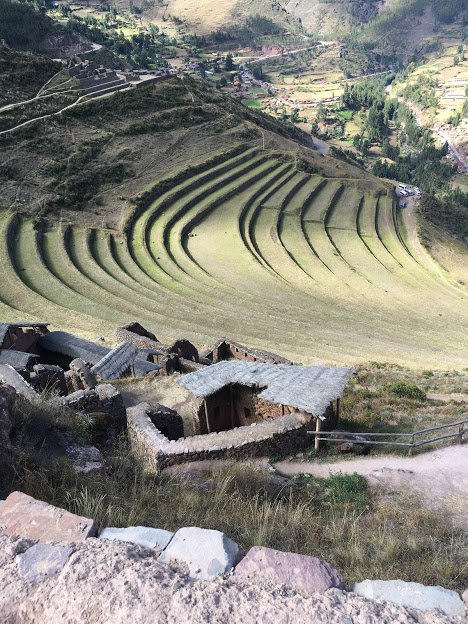
Next, we headed to the town of Pisac, where we grabbed a light lunch of empanadas and coffee at a local shop. The freshly made bread was excellent and quite filling! From the town of Pisac, it was about another 30 minutes to the archaeological site of Pisac overlooking the city. The site, high up in the mountains, gave an impressive vista of the full scope of the terraces in the valley. As we walked around the site, I hiked up to the Intihuatana, or Sun Post. This was listed as an elevation of 11,528 feet, which you certainly felt hiking up! The steps were not challenging themselves. Looking down, you could see how the citadel was laid out, and how water sources were channeled into the site.


Terraces at Pisac

We moved on to Tambomachay, which looked like a rest stop along the old Inca trail. Walking to the main spot, we walked along the original stones of the Inca trail. The site consisted of several aqueducts that may have been used for both water transport as well as hydration and bathing. While interesting, the site was small and self-contained, so we left after 15 minutes. 

By this point, it was the late afternoon and the sun was slowly starting to set. We had two sites left: Q’enqo and Saqsaywaman. Q’enqo was the old royal funerary of the Inca. At the center, a cave-like area acted as a mortuary, where the deceased corpse was embalmed and prepared for passage into the after-life. As we prepared to depart to our last site, we could see the city of Cusco reappearing in the distance.

Saqsaywaman was quite a way to end a packed day. Large stone walls had been erected, again with the dry technique, along multiple terraces. The site overlooked the valley in which Cusco sits, providing impressive views of the city including Plaza de Armas. When the Conquistadores came, they used the site as a quarry, taking much of the stone away to build the cathedral and other buildings around the city. Even in its post-Conquistador state, it was quite impressive. One can only imagine what the site looked like in its original state.


Ruins at Sacsayhuaman

Elvis dropped us off at the hotel, leaving us to prepare for our trip to Machu Picchu the next day.


Disclaimer

Friday, September 14, 2018

Cusco Day 1: Qoricancha and Plaza de Armas

Peru Day 2: After a continental breakfast in the spacious restaurant area of the Wyndham, we headed back across the street to the airport. We collected our boarding passes for the Latam flight to Cusco and headed to the gate. 

There was a giant TV temporarily set up in the gate area and the Mexico-Sweden match was being watched by dozens of people. The locals here take their soccer seriously! Peru being in the final 32 of the FIFA World Cup may have added to the hype. 

We made it until half-time, but then had to leave as they switched our gate. Unfortunately, the new gate had no such TV. Eventually we boarded buses to drive out onto the tarmac to board the actual plane. My mom was a bit worried that we would have difficulty boarding if we were at the end of the line, but funnily enough, the buses invert the order. Last in the bus is first on the plane, a neat example of LIFO (last-in-first-out). 


Once on the plane, we were further delayed about 45 minutes, but eventually had a smooth flight of about an hour into Cusco. The flight attendants only served water, but that made sense given the listed short duration of the flight. Prior reviews had noted that flights into Cusco can be variable given weather conditions there, although our delay seemed mechanical.

Gorgeous views of the Andes greeted us as we flew east towards Cusco. Descending into the Cusco valley gave us panoramic views of the city, culminating in a remarkably smooth landing. The real turbulence though came once we stepped off the plane: the altitude change is real! All three of us felt somewhat lightheaded and imbalanced as we walked the relatively short distance from the gate through the terminal.


Once outside, we ended up taking a private car which cost 35 sol (S/35 is about $10 USD). The taxis outside were reportedly as low as S/15-20 but our taxi was fine, taking us to our hotel in about twenty minutes. We stayed in Casa Andina Standard Catedral, located at NE corner of the Plaza de Armas / Catedral area, the center of Cusco. The hotel room was nice and quiet, with 3 separate beds - quite a rarity!

Iglesia de Compania de Jesus, Plaza de Armas, Cusco
After dropping off our bags, we made our way first to the nearest tourist office to purchase the ‘boleto turistico’ or tourist ticket. The ticket cost S/130, but allowed for 10 day access to most of the major points of interest around Cusco / Sacred Valley. They only accepted cash.

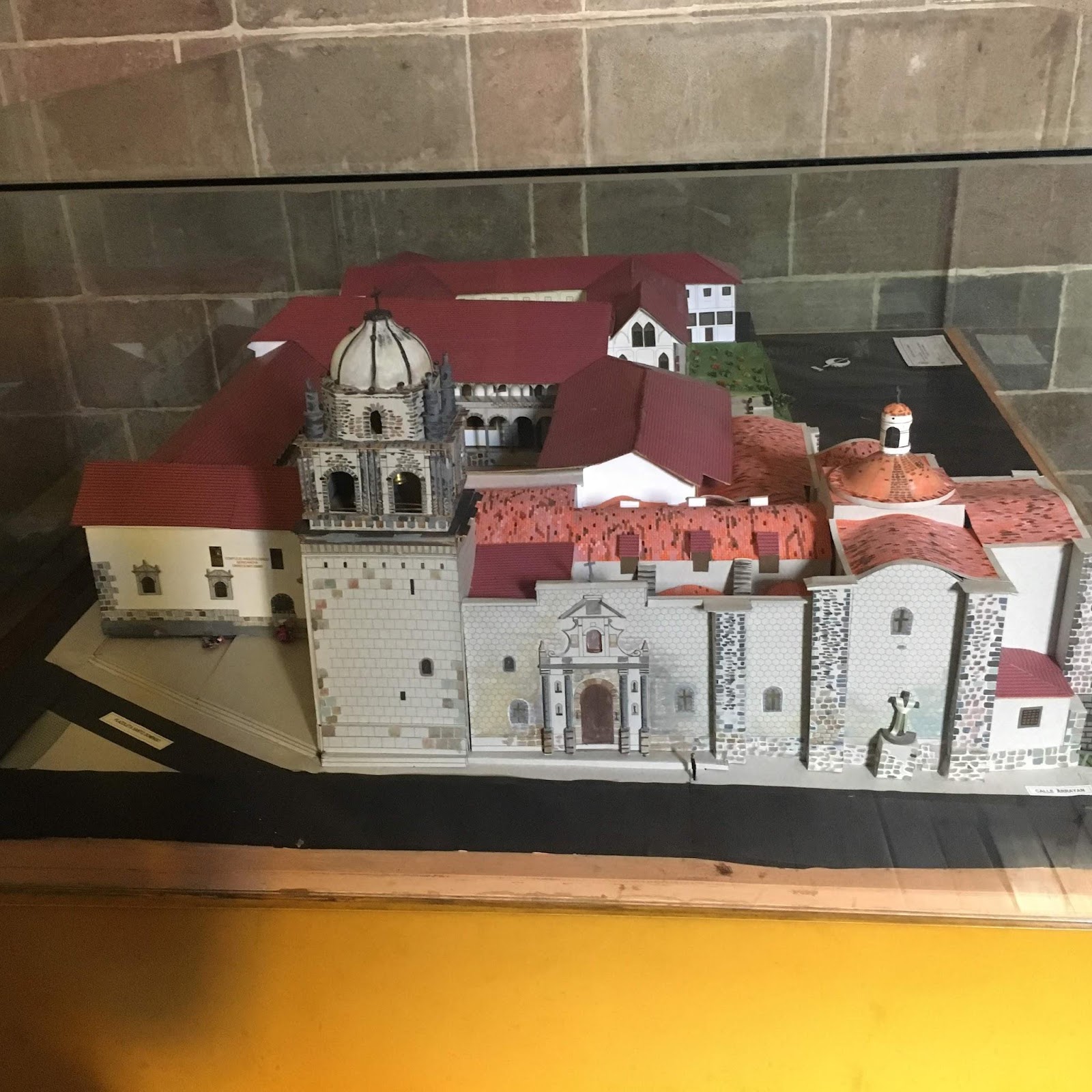
Unfortunately one of the excluded sites was our next stop Qoricancha (also spelled Coricancha or Koricancha). The term comes from the Quecha language for ‘golden enclosure.’ Qoricancha was the most important temple in the Incan Empire. Most of the gold was given to the Spanish though, as ransom for the return of the Incan leader Atahualpa. The Spanish then built the convent of Santo Domingo on the foundations of Qoricancha, so what exists today is a hybrid of the two. To enter, we purchased tickets for S/15 each.

A Scale Model of the Church / Qoricancha


The inner courtyard contains two levels. Around the perimeter, the old Incan masonry still exists. It is quite distinct as they fitted stones together without the use of mortar (also known as 'dry' mortar). As impressive as it is in photos, it is still something else to see up close. After walking the perimeter, we ventured upstairs, which connected to the Santo Domingo portion of the facility. The church itself was nice but I found the display of the old ornate garments worn most interesting.

Upon heading back outside, we went to Casa Cancha, a museum of Incan artifacts, under the mistaken impression that it would close within an hour. Luckily for us it was actually open until 7pm! Unluckily for us, they charged us another S/20 to enter. Inside though, the exhibits were well worth it, with two floors of what looks like a converted hacienda dedicated to Incan artifacts.

After the museum, we met with our tour guide for the latter half of our trip. We had planned to visit Manu National Reserve, the Peruvian portion of the Amazon, where its headwaters start. Initially, we were planning on doing a more popular circuit of Lima - Cusco - Machu Picchu - Puno - Lima. However, after learning about Manu, my parents decided to amend the trip to remove Puno and shorten Lima to create time for a 3 day / 2 night tour of Manu. Our guide Mr. Abraham of Amazon Trails Peru met with us at our hotel to go over the trip itinerary and fit us for rubber boots for hiking in the rainforest.

We ended the night with dinner at Greens Organic. The restaurant was on the 2nd floor of the building two doors down from our hotel. It served organic food with a large range of vegetarian options. We had the African curry, spinach ravioli, and sweet potato gnocchi along with coca tea infused with ginger and lemongrass. All were excellent. After dinner, we walked around Plaza de Armas and purchased bottles of water before retiring for the night.


Disclaimer

Thursday, September 13, 2018

Visiting Peru

My parents and I visited Peru from June 26 to July 6. We traveled to Lima from Houston IAH, and visited Cusco, Machu Picchu, Manu National Park, and Lima during our stay there. The following series of posts describe our journey in greater detail.

My parents and I departed from Houston Bush Intercontinental Airport (IAH) at about 4:30pm via Terminal D (which is connected to the E gate we actually flew out of). Since we arrived about 90 minutes early, we waited in the KLM Lounge just across the pedestrian bridge in Terminal C. The lounge was comfortable with small snacks available in buffet style. Most people were watching the end of the World Cup match that was on. We headed towards our gate about 45 minutes before boarding.

The flight of 6.5 hours passed quickly, spent mostly watching movies on the on-board entertainment system. Upon arriving in Lima, the gate and immigration area were easy to navigate. They now do their visa electronically, so the yellow entry form we were advised to hold onto from multiple sources was no longer given out. As we were departing for Cusco early the next morning, we stayed at the Wyndham Costa del Sol airport hotel, directly across the street from the baggage claim area. The room was quiet and comfortable, and we quickly fell asleep.

Read the next post about our journey to Cusco the following day.


Disclaimer

Monday, March 12, 2018

Drive by Daniel Pink: A Review

Daniel Pink is a former law school graduate and speechwriter for Al Gore. After those experiences, he became an author and public speaker. His most well known work is Drive, a book about motivation.

Pink starts off by describing basic research about motivation. He references work that shows  monkeys can be motivated by intrinsic rewards, the satisfaction of completing a task itself. Introducing extrinsic rewards (food) reduced output, possibly by decreasing intrinsic motivation. Drive looks at:
1) flaws in reward/punishment systems
2) how organizations use autonomy, mastery, and purpose to progress
3) resources to help such behavior flourish

Pink defines hygiene factors as items which are necessary but not sufficient for satisfaction; their absence is negative, but their presence does not lead to job satisfaction. For example, lacking a good parking spot will be very frustrating, but having one does not create joy or loyalty to a particular role. The old framework of motivation is Motivation 1.0 is basic human needs (food, etc); 2.0 is seeking rewards avoiding penalty. This structure echoes Maslow's hierarchy of human needs. Pink argues for new system based on autonomy, mastery, and purpose.

All activity can be broken down into physiologically necessary, play or work. The first one is a requirement to live, so usually does not require motivation. Similarly, play by definition should be pleasurable and not require any focused effort. Therefore, motivation must be applied to something, which we usually call work.  Per Pink, algorithmic work can be outsourced or automated; artistic, empathic, non-routine work generally cannot.

At first blush, one would imagine that incentives would help people be more productive, by greasing the wheels of motivation. And in some domains, this works. Extrinsic rewards help narrow focus; good for algorithmic tasks. However, these same incentives can be self-defeating for creative/heuristic ones. They can also cause people to take too many shortcuts to meet an extrinsic goal. Non-tangible rewards (like praise) can be equally effective, and less corrosive over time.

As work has evolved, people look to get different things out of the work they do. Management systems are antiquated. Pink refers back to his three main concepts: Autonomy requires self control over task, time, technique, and team. Mastery is the desire to get better and better at something that matters. Purpose is finding work worth doing.

In the latter part of the book, Pink leans heavily on the work of psychologist Mihaly Csikszentmihalyi ( a future post will cover his book Flow). The idea of a flow or autotelic state is one of working towards a self-defined purpose. Personally, running serves that purpose. I find fulfillment when I run, independent of an extrinsic motivation. Pink notes that flow works best for Goldilocks tasks: tasks that are not too simple nor too difficult, but repeatedly reaching a flow state is a key to mastery.

Pink's Three Laws of Mastery are:
1. Mindset (growth)
2. Effort (pain/grit)
3. Asymptotic (never fully achieved)

Pink ends by quoting Csikszentmihalyi: "One cannot lead a life that is truly excellent without feeling that one belongs to something greater and more permanent than oneself." Overall, the message is the book is well-taken, but it serves more as a summation of others' work rather than original thinking or research on the part of Pink. This still has value, similar to Malcolm Gladwell's ability to distill concepts in a way that reaches a broader swath of people, but if you have time, I encourage you to read the books by the primary researchers like Csikszentmihalyi and Dweck to get more out of the exercise.


Disclaimer

Thursday, March 8, 2018

Grit by Angela Duckworth: A Review

Angela Duckworth is a psychology professor at U. Penn. A former Marshall Scholar and MacArthur Genius grant recipient, she is best known in the popular media for her book "Grit: The Power of Passion and Perseverance." The book describes what characteristics transform one's potential into action, and how it often is not what we presume initially. She describes her theory of grit, and why this characteristic may matter more than other more specific talents.

The book notes that "Our potential is one thing. What we do with it is quite another." As a society, while we appreciate effort, we seem to value the effortless talent, the prodigy, the one for whom everything comes easy. Duckworth terms this the 'naturalness bias.'

Her theory boils down to acknowledging some amount of natural talent must be honed through effort to develop skill. That skill must subsequently have more effort applied to it in order to reach achievement. Symbolically:

Talent x Effort = Skill; Skill x Effort = Achievement. 

Duckworth goes to on to define grit as the ability to stick with an endeavor even when it gets unpleasant. Grit has two main components: passion and perseverance. Most people are slightly more perseverant than passionate, but both are important. Grit helps you to hold the same top level goal over time, which lets you determine lower level goals. Say your goal is to run a marathon. This certainly requires passion, either for running itself or for the idea of fitness, as well as perseverance to do all the training required. However, once you set that top level goal, it helps organize lower goals such as buying the right shoes, eating healthy, and scheduling time for runs.

As we grow older, our experiences help us develop grit as we realize what is important to us and how to push through challenges. Duckworth defines the following four psychological assets that help "gritty" people:
  • Interest: intrinsically enjoying what you do.
  • Practice: daily discipline
  • Purpose: the conviction that your work matters
  • Hope: it occurs at each of the prior 3 stages, as it keeps one going even when things are tough
What should one do if you do not have a defined passion? Instead of latching on to one particular topic, just follow your curiosity. Find things that excite you, then double down on where your interest lies. A future post will cover Flow, a book by psychologist Mihaly Csikszentmihalyi, that describes the state of being fully engaged at the task at hand. While these may not represent personal passions, finding yourself in a flow state for a topic that engages you is a good key to recognizing a passion.  Duckworth argues that to discover a passion you should:
  • Begin with answers you are most sure of and build from there
  • Don't be afraid to guess
  • Don't be afraid to erase an answer that is not working out

Over time, your passion deepens your interest. As you mature to an expert, you notice details that escaped you when you were a novice. However, sometimes you hit a plateau. What will separate those with grit from the rest is the ability to still find ways to improve. The Japanese word kaizen, meaning continuous improvement, epitomizes this concept. To progress, you  must continue with deliberate practice, a notion popularized by psychologist Anders Ericsson in his book Peak (you may have heard of him in association with the 10,000 hour rule). Instead of avoiding negative feedback, gritty individuals seek it out as a means towards improvement. How to improve at deliberate practice? Duckworth suggests knowing the science/existing knowledge base behind an activity, making the work a habit, and looking at the work from different perspectives. You want to be aware of what you are doing without judging yourself too harshly for any shortcomings. We tend to be our own harshest critiques as we get older.

Going beyond grit though, Duckworth does acknowledge that what we apply our efforts to matters. One could stuff envelopes with 'grit,' but most would not see that as much of an accomplishment. Grit must attached to work that has purpose. Purposeful work is consistent with one's core values and makes a positive contribution to society. Growth mindset (as popularized by Stanford psychologist Carol Dweck) goes hand in hand with grit.

Duckworth concludes by referencing the renowned playwright George Bernard Shaw:
The true joy in life is to be a force of fortune instead of a feverish, selfish little clod of ailments and grievances complaining that the world will not devote itself to making you happy

Later research has pushed back against the idea of grit having much causal/explanatory power in successful outcomes. Clearly, grit is hard to measure but the general idea still make intuitive sense: people who succeed tend to do so by persevering where others would give in, usually due to an underlying passion built from a mix of innate interest and earnest efforts toward improving themselves. To understand Duckworth's ideas in greater detail, check out Grit:


Disclaimer

Monday, January 22, 2018

Designing Your Life by Bill Burnett & Dave Evans - A Review

Burnett and Evans of Stanford University developed Designing Your Life from a popular course they taught together. With their design background, they bring a fresh perspective on how to approach some of life's challenges for which there is no 'right' answer. Their main approach is the idea of reframing challenges. For example, the notion that 'Your degree determines your career' is reframed by noting that 75% of college grads end up working careers unrelated to major. Instead of aiming for success as a means to a happy life, they argue that happiness springs from a "designing a life that works for you" and noting that it's never too late to start designing your ideal life.

 What does it mean to have an ideal life? Many people, myself included, have spent many years shaping a life as a goal-directed activity: get good grades, admission to a particular school, work towards a certain job. However, much like a dog chasing a car, what does one do when you 'catch' your goal? For small goals, you may move onto your project, but if the pursuit of a fixed goal is the organizing principle of your life, you may find yourself suddenly adrift. Burnett & Evans counter that designing a life does not involve a clear goal, but is instead "generative - constantly creative, productive, changing, evolving, always with possibility for surprise."

I lose the authors a bit at their next point. They view passion as the result of good life design, not its goal. To me, passion is both an input and an output. Without passion, how would one know where to invest their energy and attention? Presuming the initial efforts yield positive results, that should increase one's sense of passion for the work, leading to further investments.

Their notion that "if it's not actionable, it's not a problem" is helpful though. Many times I find myself perseverating on so-called "problems" that I cannot actually act upon. Reminding myself helps to focus my efforts on the areas that are truly under my control. We all want to feel secure that our actions lead to a future we are comfortable with, that we are in control of our fates, even if we acknowledge that the future is unpredictable (as argued in Stumbling Upon Happiness, perhaps happiness itself comes from being in control). Burnett & Evans flip the script on this notion by positing that by designing something, you change the future that is possible.

To start designing, it is important to start with your values. What actually matters to you? The book introduces the idea of coherency, which is the idea of living in alignment with who you are, what you believe, and what you are doing, while not sacrificing your integrity. After defining these notions, they go on to describe a Workview and a Lifeview, which are your personal responses to the purpose of your work and your life. Used together, they form a compass to guide whether you are on the right path or not.

Once you have these fleshed out, they suggest using wayfinding to guide your next steps, by seeing how your energy and engagement respond to different endeavors. Ideally, you are looking to achieve a state of flow, the feeling of being completely engaged in the activity on which you are focused. That's right - no email alert, tweet, or notification can distract you when you are in this state. Achieving this is not easy, but that is okay. You want to collect data about yourself and peak experiences to build a life that fulfills you.

I often feel that I am stuck or need to find the perfect idea, but the book argues to reframe this by reminding myself that I can generate many ideas, and can explore many of them. Instead of trying to find the "perfect" life, accept that there are multiple great lives that are possible and we get to choose which one. To test out different theories, it helps to build prototypes. For example, if you are dissatisfied in a sales job and think you might want to teach, why not try tutoring students on the weekends to see how it fits?

You want to generate 3-5 options. To help, ask people you already know how they approached such decisions. I am not naturally inclined to network, but when reframed as asking for directions or help, it makes the effort a little easier. At this stage, make the best choice possible, let go of the rest, and move forward. Remember - you can always design your way into something else if you need to in the future. Lastly, you are not alone in this journey. Ask for help in living and designing your life from others.

The book suggest several exercises to help catalyze your thought process. They are admittedly a little bit out there, but a bit of forced discomfort can actually help you be honest with yourself. As Richard Feynman once said, "The first principle is that you must not fool yourself — and you are the easiest person to fool." I cannot say I did all the exercises, but the ones I tried were helpful in letting me see where I was getting in my own way.

Designing Your Life will not give you a specific plan on how to fix your life. And that's the whole point! There is no one-size-fits-all plan. What it will do is help you spark thoughts about how you can help yourself.


Disclaimer