Showing posts with label manu national park. Show all posts

Thursday, September 20, 2018

Manu National Park Day 3

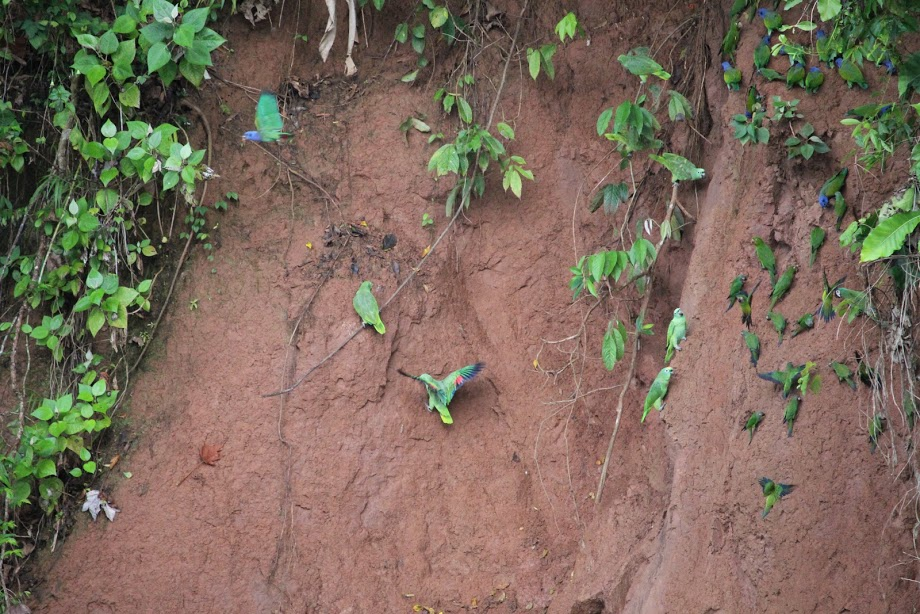
Peru Day 8: The highlight of Day 3 and arguably the whole Manu trip was the early morning bird watching. We woke in the dark and made our way down the steps into the boat. As we were on the water, the first rays of light began to creep across the sky.


You would think we would be alone in that quiet world, but we were actually part of a crowd. Many tours brought their visitors down river to a spot known for birdwatching. We disembarked on a rocky shore and climbed a small embankment to a viewing spot. We spent about 30 minutes looking around, but Abraham noticed a hawk in the distance, altering the parrots’ path.

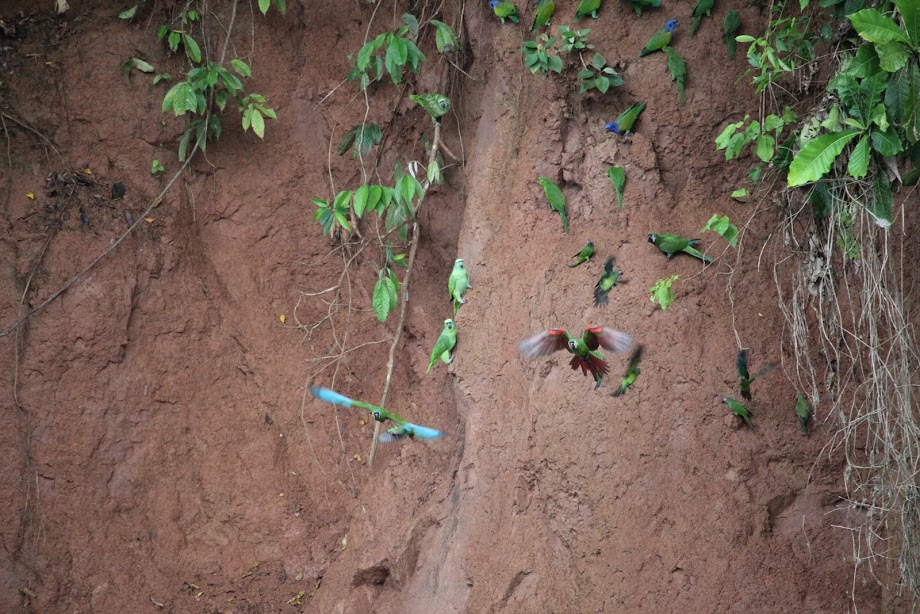
We shifted a bit upstream, approximately 300 yards. We looked back towards the shore, where a wall of brownish-reddish clay stood along the banks, partially hidden behind the trees. Soon, a crescendo of mostly green parrots arrived, feeding on the clay itself. If you looked carefully, you could see their vibrant underbellies as they flapped their wings, revealing a full spectrum from bright reds to dark blues. The birds seemingly took turns, hopping on and off the wall. Abraham said this was likely to scout for predators, as the birds were completely unprotected when they were feeding and facing the wall.

The real treat came as the boats headed back, because the view from the boat was actually even closer to the wall, albeit less steady. The surprise caught me a bit off guard, as I had already packed up my camera. Luckily, there was enough time to still capture a few shots of the birds fully in flight.


The rest of the day was spent packing up and heading back to Cusco, unwinding our journey into the heart of Manu. Even the ride back though held surprises, such as this pair of toucans!

Two toucans

We reached back to Cusco at night and looked forward to sleeping in before our flight to Lima the next morning.


Disclaimer

Wednesday, September 19, 2018

Manu National Park Day 2

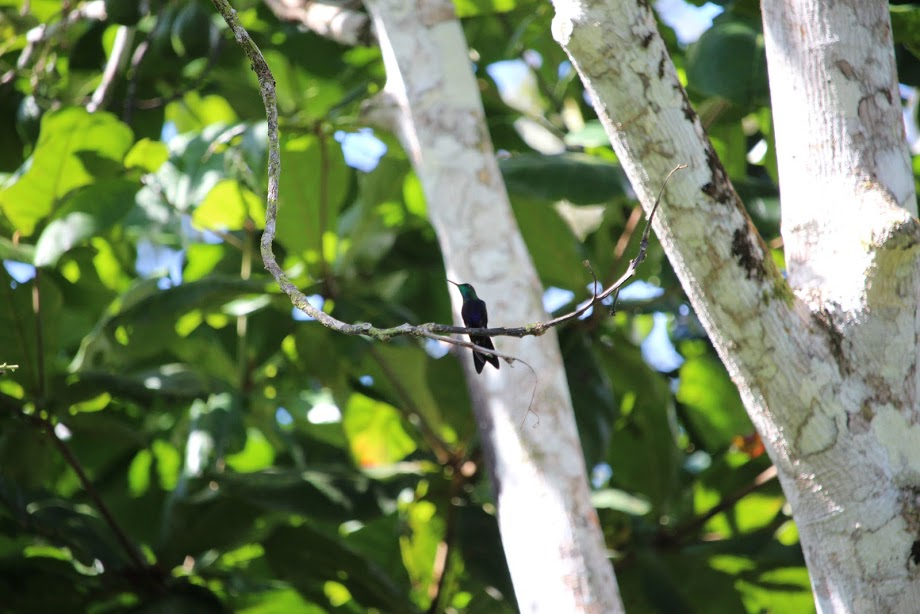
Peru Day 7: We awoke before sunrise again for an early breakfast before setting out for the day. The courtyard in the center of the lodges itself was quite rich with wildlife, including several species of orchids. A feeder was effective at attracting several hummingbirds, darting back and forth faster than the eye could fully perceive. We also enjoyed seeing the sun set the clouds aflame as dawn slowly broke.
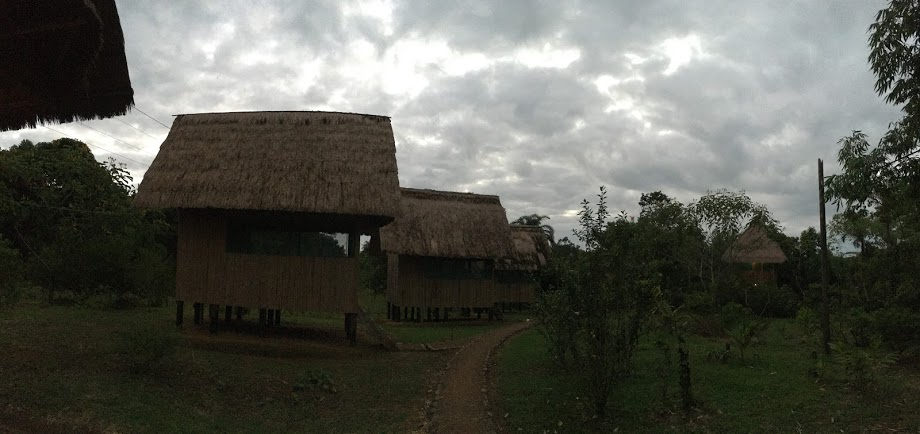
Huts at Bambu Lodge

Sunrise at Bambu Lodge

After eating, we strolled by the roadside as the van was prepared for the day. Even on an unassuming stretch of road, the amount of novel wildlife was quite impressive. Touch-me-not plants, hordes of soldier ants, and countless flowers dotted the roadside.

The van caught up with us and took us onward into the forest. Many birds dotted the sky, but Abraham was particularly adept at spotting the rarer species. He seemed to do this as much by sound as by sight, but the two senses were tightly paired. Even if he could identify a bird’s call, it would not be much use without being able to pinpoint the source. The highlight of this was spotting a toucan in a far off glade of trees, and then capturing the bird in flight.
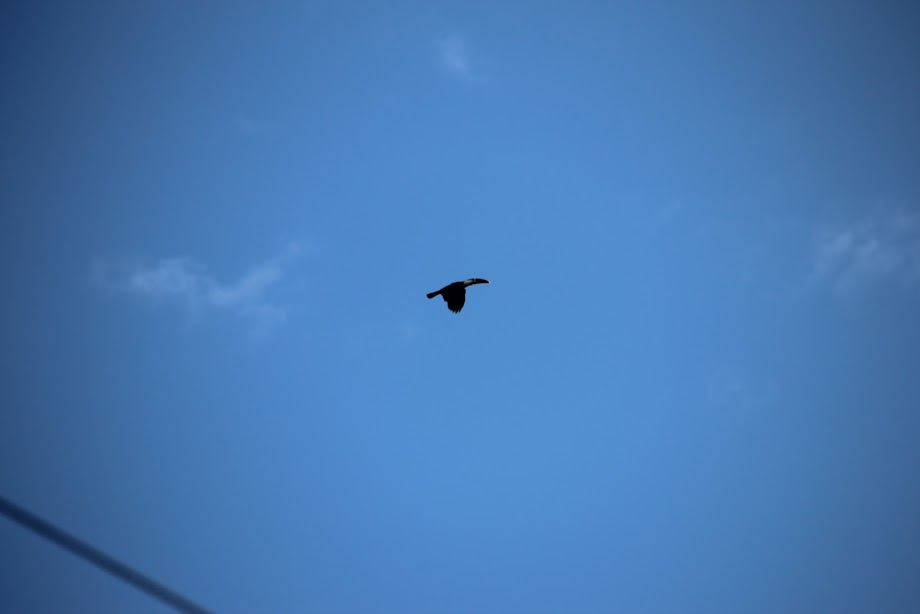
Flying toucan
We saw many oropendelas (golden tailed birds) and parrots as well. As we went deeper into the forest, the bird density increased. Flocks of macaws flew overhead as we crossed one of the many streams.

Along the way, there was a petting zoo. While not fully ‘natural’, the animals were free to roam around the place, and let us see some of them up close. There were several species of parrots, a turtle, sloth, monkey, and a very friendly pig.

Similarly, we stopped by an orchid garden that was truly a labor of love of the gardner. I do not recall his name but he was generally regarded ‘The Orchid Professor.’ This was not just hyperbole as he actually had a species named after him! We saw dozens of species, including some of the tiniest orchids one can imagine, no bigger than a few grains of rice.
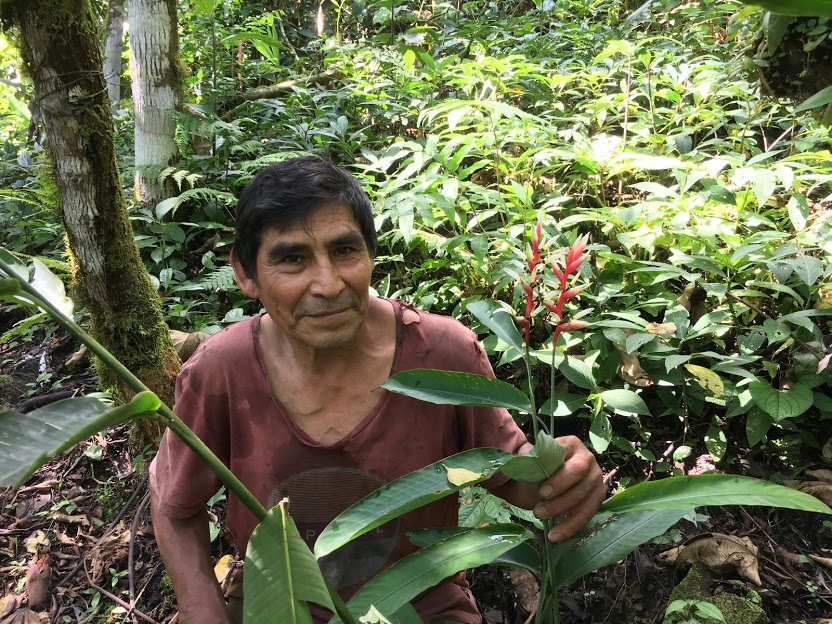
The Orchid Professor of Manu
We eventually ended up driving along a ridge overlooking a broad river plain surrounding the Atalaya River. Our tour shifted to its water-faring stage, as we unpacked the van into a boat. We did a short tour up and down the river for about an hour, seeing waterfalls and other river traffic as we motored along. Eventually, we pulled up to the banks of the river with a steep set of stairs leading up to our night lodging.

Unlike the Bambu Lodge of the night before, the Sago de Oro lodge had no electricity but it did have solar-heated hot water. This lodge was more deeply set in the jungle, with numerous birds darting around, in particular hummingbirds.

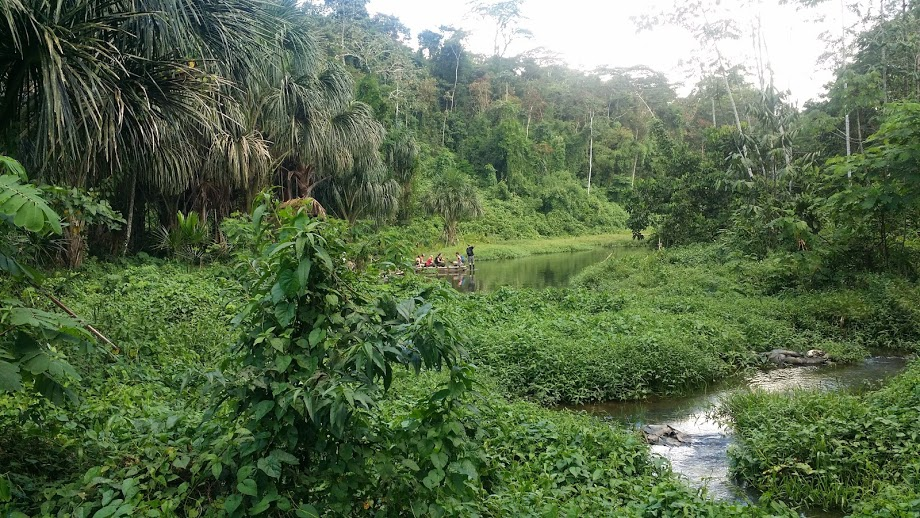
After a short break for lunch, Abraham took us for another hike around Machuwasi lake, which was more like a lagoon. We hopped back in the boat and headed downstream. We disembarked on a pebble-strewn beach on the opposite bank and started hiking into the jungle. The boots sure came in handy with all the mud! After about 45 minutes, we came into a clearing where we waited to board a raft.


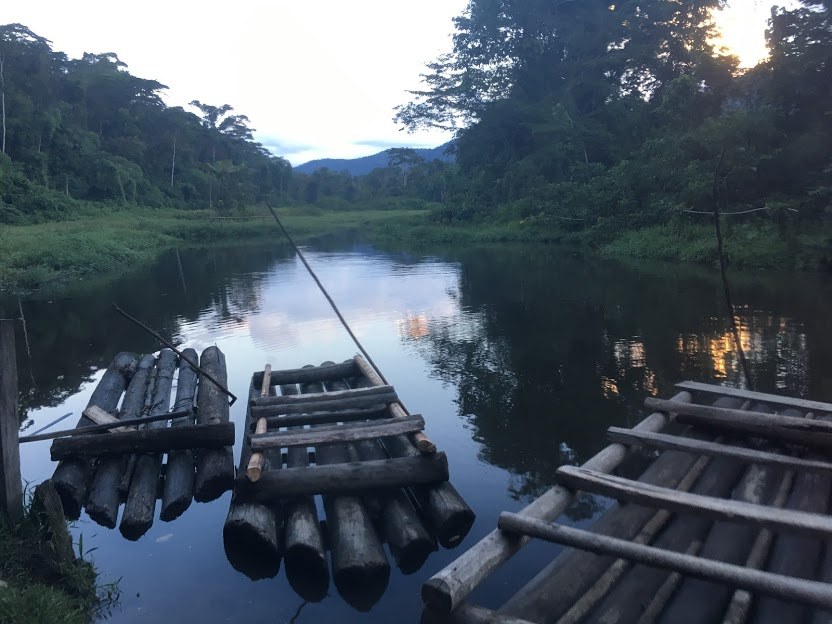
The raft slowly drifted through a lagoon, with Abraham occasionally paddling but mostly pointing out the various animals around. We saw many bird species but the most interesting to me was the baby capybara! The capybara is a South American mammal that resembles a giant guinea pig. The evening was quite tranquil and memorable.

On the hike back, night befell us. We were prepared from the night before, so we felt more comfortable when Abraham wanted to stop and try to spot a caiman, the South American version of an alligator. He spotted one and centered the scope on it, but initially I had a tough time making it out against the muddy background, until all of a sudden, his yellow eye came into focus, staring right back at me! It was chilling because one could easily imagine wading into the water unaware of the danger lurking nearby. We soon made our way back to the boat and lodge, settling in early for another early rise the next day.


Disclaimer

Tuesday, September 18, 2018

Manu National Park Day 1

Peru Day 6: With the moon still in the sky, we embarked on our 3 day-2 night journey to Manu National Park, an expansive protected area east of Cusco and Machu Picchu that housed the headwaters of the Amazon forest. The area is also a protected cultural zone. The journey would cover a descent from 11,000 ft to only 2,000 ft. Our guide Abraham with Amazon Trails Peru picked us up in a large van with a driver and a cook. We easily could have seated 3 more people in the large space.

As we drove out of the city, we picked up fresh bread on the roadside at the edge of the city. School-age girls clustered around the van in the pre-dawn chill, waiting to hand us the goods. To my eye, standing out in the freezing cold would have been quite terrible, but from their smiles and laughter, the girls showed no sign of discontent. Bread packed, we continued on our way into the mountains.


Our first stop was at Chullpas de Dinamarca, ancient tombs of a pre-Incan civilization. Supposedly, the royals were embalmed and entombed in these circular clay tombs. They appeared like a series human-sized chess piece castles dotting the hillside. A small rectangular window was carved into one side, but not much was visible within. The views of the surrounding valleys were quite impressive -- all things considered, not a bad sight for eternity. 

Tombs at Chullpa de Dinamarca on the way to Manu
Next, we headed to the town of Paucartambo, which lay along a river with the same name. As we took a cup of coffee, our driver went to get a tire fixed. We sipped the rich Peruvian coffee in a small shop as a World Cup soccer match played on in the background. The sun was fully out now and the heat was building.

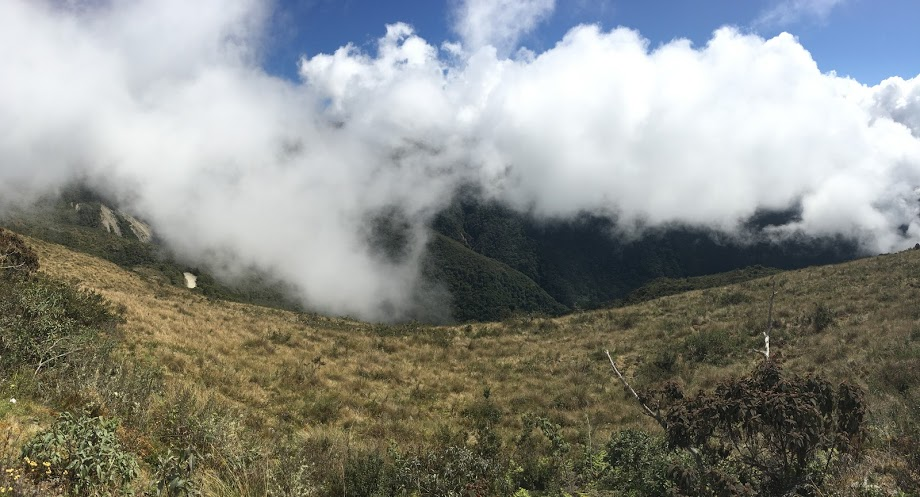
As we continued onwards, we descended further and the surround flora began to change. The mountainous areas soon became more forested. As we crossed the simple park entrance, we entered a zone called the cloud forest, and the views did not disappoint. It truly felt like we were staring at the clouds, eye-to-eye, with hints of a forest peeking in and out as the clouds slowly sauntered by.

Cloud Forest
We eventually pulled over to the side of the road. Abraham was very sharp at spotting unique plants and birds with his naked eye, but his scope proved invaluable in bringing out the detail in the forest background. Even my SLR zoom lens was no match. As we took in the sights, the driver went ahead and set up a picnic table for lunch in a clearing up ahead. We enjoyed a fresh lunch with the rainforest surrounding us.

We drove deeper into the forest until we came to a viewing deck for the Cock of the Rock, a colorful bird that tends to cluster in a few areas in the forest. The males have a colorful orange head that are hard to spot initially but once seen, hard to miss. Standing there for 15 minutes, we spotted at least 7 flying around between the trees.

Cock of the Rock
Our last sight of the day before halting was a pair of monkeys, feasting on tree blossoms. 


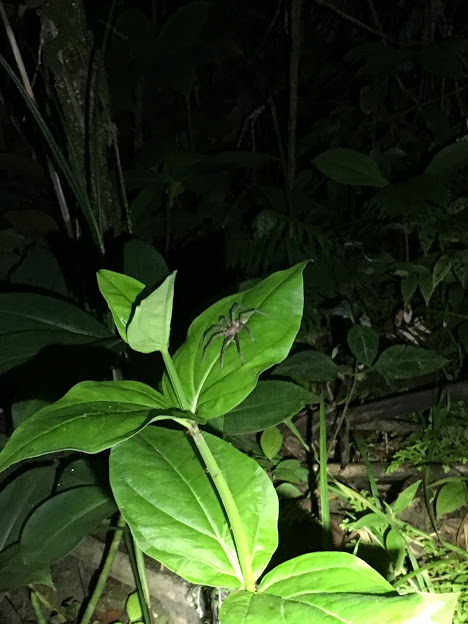
We then headed to a bamboo lodge. The rooms were simple - beds with restrooms, lit but without hot water. After putting our bags down, Abraham took us on a night hike into the forest. I presumed we would have some background light from the moon and stars but was I wrong! The unassuming canopy overhead by day acts as shut out curtains by night. We were in pitch dark with only our flashlights to guide us. Walking became much more hazardous as it was very easy to trip over roots or other irregularities in the ground. While Abraham forged ahead undaunted, we 3 clutched each other as we cautiously inched forward. Abraham pointed out the ‘night life’, mostly spiders and moths. After about an hour, we headed back. We retired for the night after a quick dinner.